Metal 3D Printing: Transforming Manufacturing and Industry
Published on: April 13, 2024
The rapid evolution of 3D printing technology has redefined the manufacturing landscape. Metal 3D printing, also known as additive manufacturing, has taken center stage, providing revolutionary opportunities for industries such as aerospace, automotive, healthcare, and more. By enabling the creation of complex designs, optimizing material usage, and reducing production times, metal 3D printing is transforming the way we produce parts and products. In this article, we explore how metal 3D printing is changing the face of modern manufacturing, its applications across diverse sectors, the current technologies driving this revolution, and the future trends to watch out for.
A Brief History of 3D Printing and Its Journey to Metals
The concept of 3D printing dates back to the 1980s when it was primarily used for prototyping with plastics. Over the decades, the technology matured and began to include new materials like ceramics and eventually metals. Initially, the idea of printing with metal seemed like something out of science fiction, but through innovation, metal powders, specialized binders, and high-powered lasers became key enablers of metal additive manufacturing.
The shift to metal 3D printing marked a significant turning point, allowing manufacturers to produce functional components that were not just prototypes but end-use parts. Metal 3D printing combines the benefits of additive technology—such as design freedom and material efficiency—with the strength, durability, and functionality of metals, expanding its impact from product development to full-scale production.
How Metal 3D Printing Works
Metal 3D printing relies on advanced technologies that fuse metal powders into solid parts. There are several different processes for metal additive manufacturing, each suited to different applications and industries. Let’s look at the most prominent metal 3D printing technologies:
Selective Laser Melting (SLM) / Direct Metal Laser Sintering (DMLS)
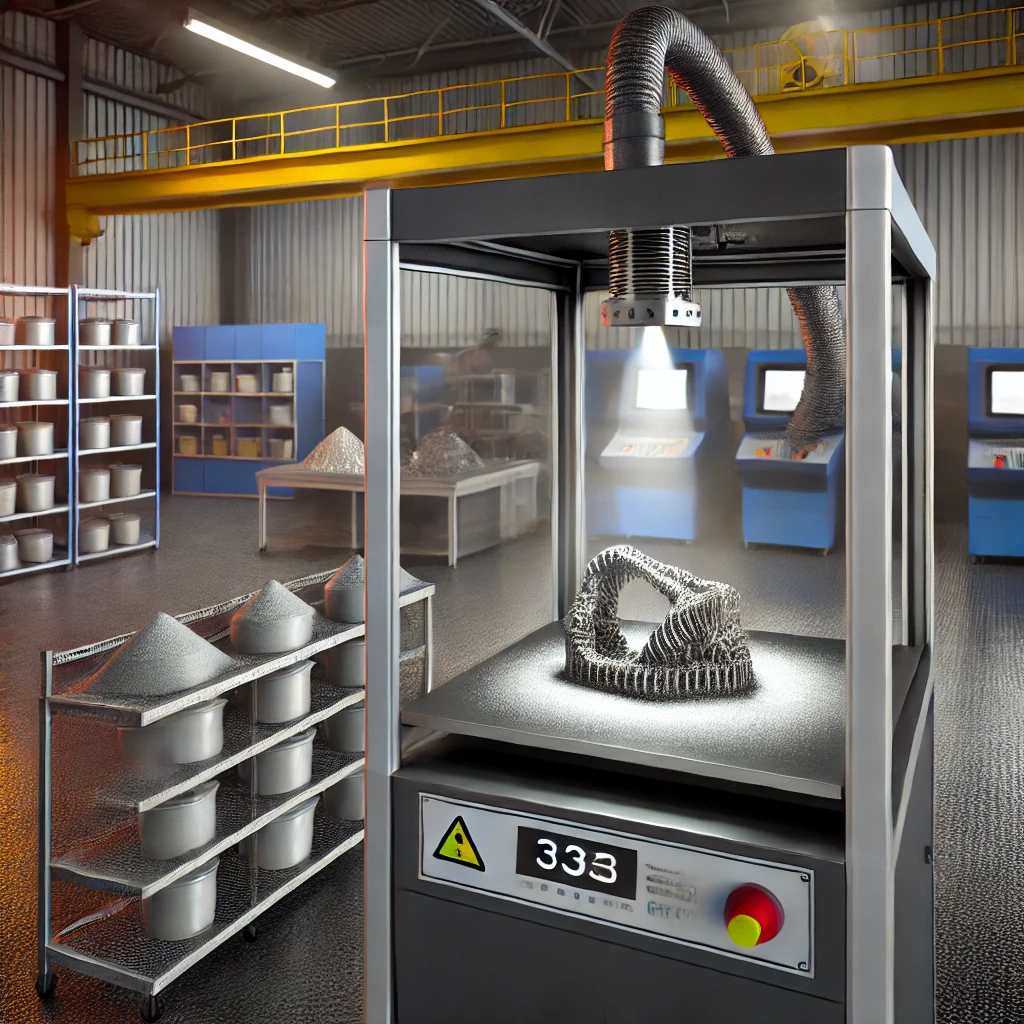
Selective Laser Melting (SLM) and Direct Metal Laser Sintering (DMLS) are the most common metal 3D printing methods, using high-powered lasers to melt or sinter metal powder layers into solid parts. The process starts by spreading a thin layer of metal powder on a build platform, and a laser selectively fuses the powder according to the design. The platform lowers, a new layer is spread, and the process repeats until the entire part is created.
This technique allows for extremely detailed and precise parts, making it ideal for industries such as aerospace and medical where accuracy and reliability are paramount. SLM/DMLS can work with a wide range of metals, including aluminum, stainless steel, titanium, and cobalt-chrome.
Electron Beam Melting (EBM)
Electron Beam Melting is a process similar to SLM, but instead of a laser, it uses an electron beam to fuse metal powder. EBM is typically used to produce high-strength components from materials like titanium. Since the entire printing process takes place in a vacuum, this method is particularly suitable for producing high-quality aerospace parts with excellent material properties.
Binder Jetting
Binder Jetting is a different approach that uses a binding agent to adhere metal powder together layer by layer. After printing, the part is placed in a furnace for sintering, which fuses the powder particles. Binder Jetting is faster than laser-based methods and allows for high-volume production, though it usually requires additional post-processing to achieve optimal strength and durability.
Directed Energy Deposition (DED)
Directed Energy Deposition is a metal additive process where metal powder or wire is fed into a melt pool created by a focused energy source, such as a laser or electron beam. This method is used to produce large parts or repair existing components, making it particularly useful in the aerospace and defense industries.
Applications of Metal 3D Printing Across Industries
The versatility of metal 3D printing has made it an invaluable tool across numerous industries. Here are some of the key applications:
Aerospace
The aerospace industry was among the first to embrace metal 3D printing. Aerospace companies use additive manufacturing to produce lightweight, strong components for aircraft and spacecraft, reducing both material costs and fuel consumption. Metal 3D printing allows the creation of complex geometries that would be impossible or too costly to achieve through traditional manufacturing.
For instance, GE Aviation uses metal 3D printing to produce fuel nozzles for its jet engines. These nozzles are 25% lighter and five times more durable than their conventionally manufactured counterparts, highlighting the value of 3D printing in producing high-performance parts.
Automotive
In the automotive sector, metal 3D printing is used to create performance parts, prototypes, and specialized tooling. By leveraging the design flexibility of additive manufacturing, car manufacturers can reduce the weight of vehicles, leading to improved fuel efficiency and performance.
Companies like Bugatti have used metal 3D printing to create components like brake calipers, which require high strength and precision. This technology also plays a vital role in producing spare parts, especially for classic cars where original tooling may no longer exist.
Healthcare
The healthcare industry has greatly benefited from metal 3D printing, particularly in the production of medical implants and surgical instruments. Patient-specific implants made from titanium or cobalt-chrome alloys can be customized to fit perfectly, reducing recovery time and improving patient outcomes.
For example, metal 3D printing is used to create custom orthopedic implants such as hip and knee replacements. Cranial and dental implants are also produced with metal 3D printing, as it allows for precise control over the implant’s structure, which is crucial for biocompatibility and integration with the human body.
Tooling and Industrial Equipment
Metal 3D printing is revolutionizing the production of tooling and industrial equipment, allowing manufacturers to create custom tools with optimized geometries and internal cooling channels that improve efficiency. 3D-printed molds, dies, and cutting tools have shorter lead times, lower costs, and can be customized for specific applications, increasing the flexibility of production.
Energy Sector
In the energy sector, metal 3D printing is being used to produce components for turbines, both in power generation and the oil and gas industries. The technology allows for optimized part designs that improve performance and durability under extreme conditions, such as high temperatures and pressures.
Benefits of Metal 3D Printing
Metal 3D printing offers several significant advantages over traditional manufacturing methods. Here are some of the most notable benefits:
Design Freedom
One of the most compelling benefits of metal 3D printing is the freedom it offers designers. Complex geometries that would be impossible or require multiple parts in conventional manufacturing can be produced as a single component with 3D printing. This includes intricate lattice structures, organic shapes, and internal channels that reduce weight while maintaining strength.
Reduced Material Waste
In traditional subtractive manufacturing, large amounts of material are often wasted when a part is cut from a block of metal. In contrast, metal 3D printing is an additive process, meaning that material is deposited only where it is needed, resulting in significantly reduced waste. This not only saves costs but also reduces the environmental impact of production.
Shorter Lead Times
Metal 3D printing enables rapid prototyping, allowing manufacturers to quickly create and test parts before committing to full-scale production. This accelerates the product development cycle, reducing time to market. Additionally, by printing on-demand parts, manufacturers can eliminate the need for inventory and long lead times associated with tooling.
Customization and Personalization
Because metal 3D printing allows for rapid design iteration, it is ideal for producing customized parts. Whether it’s a patient-specific implant in healthcare or a tailored component for a high-performance car, customization becomes economically viable with additive manufacturing.
Lightweight Components
The ability to create lightweight components without compromising strength is particularly valuable in industries like aerospace and automotive, where reducing weight translates to significant savings in fuel and emissions. Metal 3D printing enables intricate lattice structures and topologically optimized designs that minimize weight while maximizing performance.
Challenges Facing Metal 3D Printing
While metal 3D printing offers numerous benefits, it also comes with its own set of challenges that must be addressed for wider adoption:
High Cost of Materials and Equipment
The metal powders used in 3D printing are expensive, as is the specialized equipment needed for metal additive manufacturing. These high costs can be a barrier to entry, especially for smaller manufacturers or those without significant financial backing.
Post-Processing Requirements
Most metal 3D-printed parts require extensive post-processing, including stress relief, machining, and surface finishing. This can add time and cost to the production process, reducing the overall efficiency of additive manufacturing.
Quality Assurance and Standards
Ensuring the consistency and quality of metal 3D-printed parts remains a challenge. Variability in powder quality, laser parameters, and thermal conditions can affect the mechanical properties of printed parts. To overcome this, standardized testing procedures and quality assurance protocols are being developed, but there is still progress to be made.
Limited Material Selection
While the range of metals available for 3D printing is expanding, it is still limited compared to the variety of materials used in traditional manufacturing. Developing new alloys specifically optimized for 3D printing is an ongoing area of research.
Future Trends in Metal 3D Printing
The future of metal 3D printing looks promising, with several trends poised to drive its growth and impact on manufacturing:
Hybrid Manufacturing
Hybrid manufacturing combines additive and subtractive processes in a single machine. This approach takes advantage of the strengths of both technologies—using 3D printing for complex geometries and CNC machining for precision finishing—to create high-quality components more efficiently. Hybrid systems are becoming more popular as manufacturers seek to streamline production and reduce the need for multiple machines.
Development of New Metal Alloys
The development of new metal alloys specifically tailored for 3D printing is expected to broaden the range of applications for metal additive manufacturing. Researchers are working on materials with improved printability, reduced cracking, and enhanced mechanical properties, which will make 3D printing an even more attractive option for a wider range of industries.
Larger Build Volumes
One limitation of current metal 3D printing technology is the size of the parts that can be produced. Advances in machine design are making it possible to create printers with larger build volumes, allowing for the production of larger components in a single print. This will open new opportunities in industries like construction and infrastructure.
Increased Automation
Automation is set to play a significant role in the future of metal 3D printing. Integrating robots, automated powder handling, and quality inspection systems will help streamline the production process, reduce labor costs, and improve the consistency and repeatability of printed parts. This push toward automation will make metal 3D printing a more competitive option for mass production.
Sustainability Focus
As environmental concerns continue to rise, metal 3D printing's ability to reduce material waste and enable lightweight, optimized designs will be increasingly important. Further development of recyclable metal powders and the use of renewable energy sources for production will contribute to making metal additive manufacturing a greener alternative to traditional manufacturing.
A Transformative Force in Manufacturing
Metal 3D printing is a game-changing technology that holds the potential to transform the manufacturing industry. By enabling complex designs, reducing material waste, and providing opportunities for customization, metal additive manufacturing is ushering in a new era of innovation across industries like aerospace, automotive, healthcare, and energy.
However, challenges such as high costs, post-processing requirements, and quality control must be addressed to unlock the full potential of metal 3D printing. With advancements in hybrid manufacturing, new alloys, automation, and sustainability initiatives, the future of metal 3D printing is bright, promising to reshape how we design and produce everything from small medical implants to massive aerospace components.
The evolution of metal 3D printing is not just about technology—it's about rethinking how we manufacture, pushing the boundaries of what's possible, and creating new opportunities for industries to innovate. As the technology matures, metal 3D printing will continue to reduce the gap between imagination and reality, paving the way for more efficient, customized, and sustainable manufacturing solutions.