Table of Contents
- Historical Context and Early Concepts
- ▶ Why Space-Based Solar Power?
- ▶ Core Technological Components
- ▶ Economics and Funding Models
- ▶ Environmental and Ethical Considerations
- ▶ Technological Breakthroughs on the Horizon
- ▶ Socioeconomic Impact and Global Policy
- ▶ Ethical Dimensions
- ▶ Implementation Roadmap and Phases
- ▶ Challenges and Criticisms
- ▶ Possible Synergies with Other Technologies
- Vision for the Future
Space-Based Solar Power: The Next Frontier of Clean Energy
Published on: February 8, 2025
Space-based solar power (SBSP) is an emerging concept that aims to capture the Sun’s energy in space—where it is abundant and uninterrupted—and transmit it back to Earth to meet our growing energy demands. In essence, SBSP envisions orbital power plants equipped with advanced solar collection systems that circumvent many of the limitations faced by terrestrial solar farms, such as weather-induced intermittency and geographical constraints. Proponents see SBSP as the next revolutionary leap in clean energy, while skeptics point to its engineering, economic, and ethical hurdles. Regardless of the stance, a serious conversation about SBSP forces us to reimagine how humanity can harness and distribute energy on a planetary scale.
In this article, we will undertake a deep exploration of SBSP. We’ll examine its history, dissect the core technological elements, and consider the ethical, logistical, and economic considerations that must be addressed before we can capture the first rays of space-borne solar power. By the end, you will have a comprehensive understanding of why SBSP is gaining traction as a visionary solution for powering the future—and the monumental challenges we must surmount to bring it to reality.
Historical Context and Early Concepts
Though the concept of harvesting solar power in space may sound futuristic, its roots reach back decades. The first serious technical study of SBSP is often credited to Dr. Peter Glaser, who proposed a space-based solar power system in 1968. Glaser envisioned large satellites equipped with massive solar arrays, beaming the energy to Earth via microwaves. At the time, even launching moderate-sized payloads to space was prohibitively expensive, and the computational tools to model such a complex system were limited. Consequently, the idea lingered on the periphery of aerospace research.
During the 1970s and 1980s, organizations like NASA and the U.S. Department of Energy sporadically revisited SBSP. However, interest tended to rise and fall in tandem with energy crises and public attention to alternative energy sources. Despite these ups and downs, a community of dedicated scientists and engineers kept the concept alive by publishing papers, organizing conferences, and incrementally refining the designs.
Fast-forward to the 21st century, and the rapid advancements in electronics, robotics, materials science, and especially launch technologies have breathed new life into SBSP. Reusable rockets, private space companies, and growing concerns about climate change have created an environment more receptive to radical solutions for clean energy—making SBSP look less like science fiction and more like a serious proposition.
Why Space-Based Solar Power?
Space-based solar power (SBSP) is an emerging concept that aims to capture the Sun’s energy in space—where it is abundant and uninterrupted—and transmit it back to Earth to meet our growing energy demands. In essence, SBSP envisions orbital power plants equipped with advanced solar collection systems that circumvent many of the limitations faced by terrestrial solar farms, such as weather-induced intermittency and geographical constraints. Proponents see SBSP as the next revolutionary leap in clean energy, while skeptics point to its engineering, economic, and ethical hurdles. Regardless of the stance, a serious conversation about SBSP forces us to reimagine how humanity can harness and distribute energy on a planetary scale.
Overcoming Terrestrial Limitations
On Earth, solar power systems face numerous limitations. Nighttime, cloud cover, dust, and seasonal fluctuations reduce the amount of solar radiation that can be captured. In addition, large-scale solar farms require vast tracts of land, which may conflict with agriculture or conservation efforts. By contrast, solar collectors in Earth’s orbit or at Lagrange points can operate nearly around the clock, unimpeded by atmospheric or seasonal variables. This essentially offers access to a continuous power supply.
Abundant Solar Irradiance
The solar irradiance in space is significantly higher than at Earth’s surface. Depending on the specific orbit, solar panels in space can receive up to 30% more energy, simply because there is no atmospheric attenuation. In a geostationary orbit (GEO), where a satellite remains over the same spot on Earth, access to sunlight can be as high as 99% of the year, excluding short eclipse periods.
Potential for Global Reach
Space-based solar power plants could, in theory, transmit energy to diverse locations on Earth, shifting their focus as demand changes or following seasonal peaks. This mobility could alleviate energy shortages in remote regions and reduce dependency on complex supply chains that currently tie energy production to specific geographic areas.
Long-Term Sustainability
SBSP systems offer the prospect of large-scale clean energy generation with minimal greenhouse gas emissions once operational. The systems do not require fresh water for cooling, as some traditional thermal power plants do, nor do they consume finite fuels. While the carbon footprint of launches must be considered, proponents argue that advancing green launch technologies (e.g., methane or hydrogen-fueled reusable rockets) could mitigate these concerns.
Core Technological Components
Orbital Platforms and Orbits
Different orbital regimes—including Low Earth Orbit (LEO), Medium Earth Orbit (MEO), and Geostationary Orbit (GEO)—each present unique advantages and challenges for SBSP. While LEO satellites have lower launch costs and shorter distances for transmission, they move relative to the Earth, complicating continuous power delivery. GEO satellites remain in fixed positions above the equator, offering consistent coverage but require more expensive and technically demanding launches.
A variant of SBSP proposes situating arrays at Earth-Sun Lagrange points—particularly L1—which remain aligned with the Sun but increase the distance and complexity for power beaming. The fundamental requirement is that the chosen orbit should maximize exposure to sunlight while minimizing transmission distances and orbital maintenance costs.
Solar Arrays and Materials
The solar collection panels for SBSP systems must be extremely lightweight, durable, and efficient. Traditional silicon photovoltaic (PV) panels used on Earth may not be optimal for space-based systems, which require resilience against radiation, micrometeoroids, and dramatic temperature fluctuations. Newer materials—like multi-junction gallium arsenide cells or perovskite-based cells—could achieve higher efficiency with less mass.
Beyond the photovoltaics themselves, the satellite structures must incorporate sophisticated thermal management systems. In the vacuum of space, heat dissipation relies on radiative cooling rather than convection, and wide swings in temperature can degrade materials.
Power Beaming Methods
Once solar energy is collected, it must be converted into a form suitable for wireless transmission back to Earth. The two leading contenders are microwaves and lasers:
- Microwave Transmission: Early SBSP concepts rely on microwave power beaming at frequencies such as 2.45 GHz or 5.8 GHz. Microwaves have the advantage of passing through Earth’s atmosphere with minimal attenuation, but they require large receiver stations (rectennas) on the ground. Safety concerns revolve around potential impacts on wildlife or humans if the beam drifts.
- Laser Transmission: Laser-based systems can operate at higher frequencies, resulting in more compact ground receivers. However, atmospheric absorption and scattering are more significant challenges, requiring adaptive optics and cloud-free skies for optimum performance. Safety measures must also be in place to prevent accidental exposure of living organisms to high-intensity laser beams.
Ground Infrastructure and Rectennas
A rectifying antenna, or rectenna, is a specialized receiving station that converts incoming microwaves or lasers into direct current electricity. These ground stations can span several square kilometers, depending on the power level of the satellite beam and the chosen frequency. The design must also address local geography and environmental regulations, ensuring minimal disruption to ecosystems or populated areas.
Robotics and Autonomous Assembly
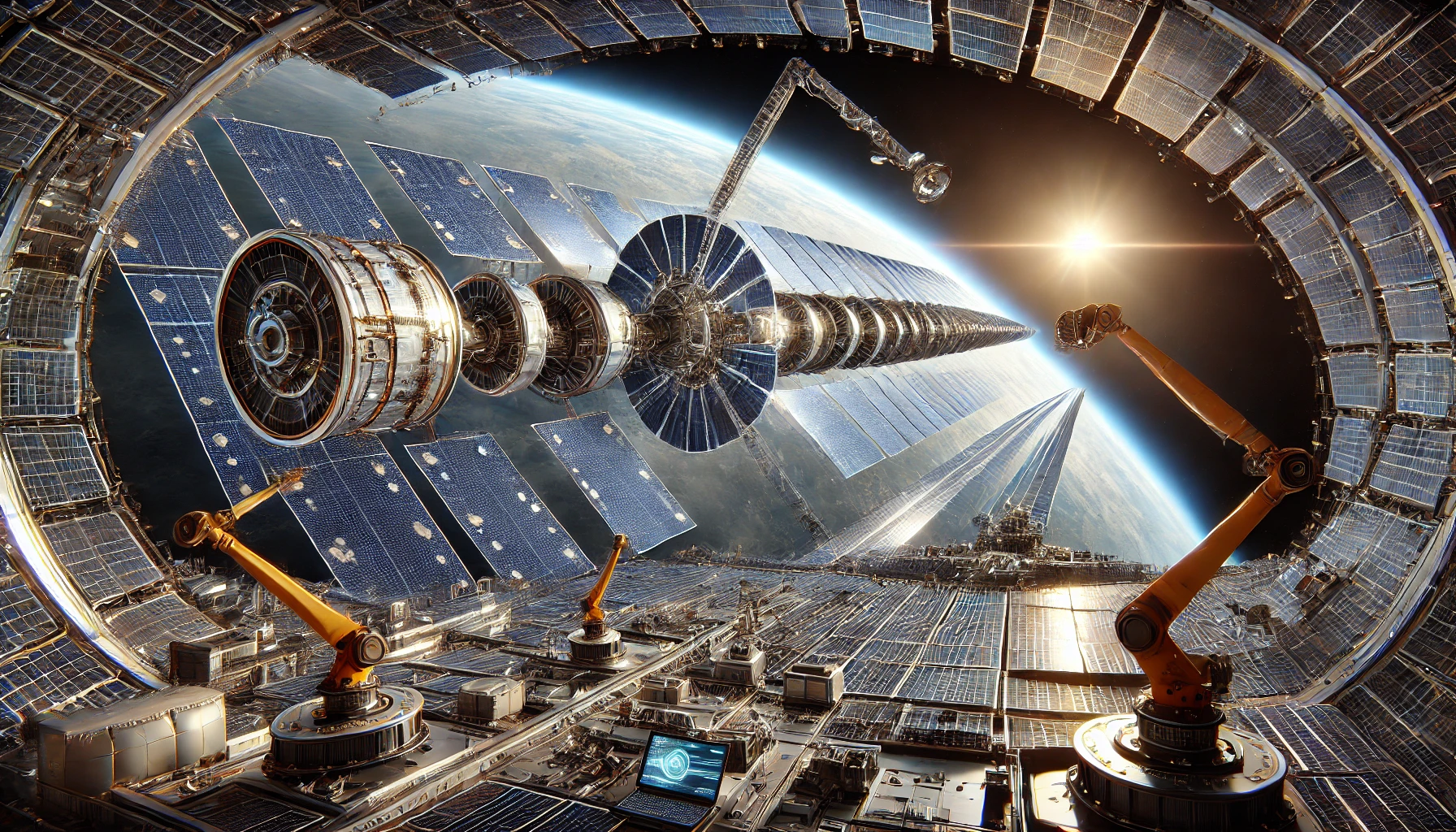
To realize large SBSP arrays, satellites may need to have areas spanning multiple square kilometers to capture enough solar energy. Such colossal structures are impossible to deploy from a single launch fairing. Instead, modular components would have to be assembled in orbit, likely via autonomous robots. On-orbit assembly and servicing of SBSP satellites represent a significant engineering and logistical challenge. The systems must be designed to dock seamlessly, connect power lines, and handle structural alignment—all while operating in microgravity.
Economics and Funding Models
High Upfront Costs
SBSP requires substantial initial investment. Launch vehicles, the raw materials for the satellites, the technology for power beaming, and the ground-based rectenna infrastructure all contribute to enormous capital expenditures. Traditional solar or wind farms on Earth appear cheaper by comparison, especially in the short term.
Cost Reduction via Reusable Rockets
One of the most critical developments that could make SBSP economically viable is the rise of reusable launch systems. Companies in the commercial space sector have dramatically cut launch costs over the past decade by developing rockets that can land and be refurbished. Further reductions in costs could result from fully reusable heavy-lift vehicles and next-generation propulsion techniques.
Potential Revenue Streams
SBSP may offer multiple revenue streams, such as:
- Utility-Scale Power Supply: Selling electricity to national grids.
- Energy Exports: Countries or corporations operating SBSP could become global energy exporters, potentially supplanting fossil-fuel-heavy trade relationships.
- Lunar or Deep-Space Exploration: SBSP satellites might provide power to spacecraft or lunar bases, extending the concept of space-based power beyond Earth.
Public-Private Partnerships
Given the enormous scope and cost, SBSP initiatives might necessitate collaboration between government agencies, international consortiums, and private companies. Public-private partnerships can distribute risk and tap into diverse funding sources, accelerating research, development, and deployment timelines. Government involvement might also come in the form of loan guarantees or feed-in tariffs that incentivize space-based power.
Environmental and Ethical Considerations
Space Debris and Orbital Congestion
Launching and deploying massive SBSP satellites in orbit risks exacerbating the existing problem of space debris. Any collision could create hazardous debris fields that jeopardize other satellites and future missions. Rigorous orbital debris mitigation strategies, including end-of-life disposal and robust shielding against micrometeoroids, must be integral to SBSP programs.
Microwaves, Lasers, and Ecosystem Impacts
While low-intensity microwaves have been studied extensively for safety, large-scale deployment raises legitimate questions about the impact on wildlife, avian migration patterns, and human communities living near rectennas. Laser-based transmission, although possibly more efficient, also poses concerns regarding accidental exposures if the beam’s alignment is disrupted or if aircraft traverse its path.
Equitable Access and Energy Justice
SBSP’s ability to deliver power anywhere on Earth opens up complex questions about who controls the satellites and how energy distribution is governed. Would a handful of multinational corporations dominate space-based power, potentially holding entire regions hostage? Could smaller nations or emerging economies access SBSP without prohibitive licensing fees? Ensuring equitable access may require transparent international regulations and treaties.
Planetary Stewardship
Some ethicists question whether large-scale SBSP might inadvertently alter the Earth’s radiative balance if huge amounts of solar radiation are harvested and beamed to different regions. While current models suggest minimal net effect, the full environmental impacts of such large-scale energy manipulation remain uncertain.
Technological Breakthroughs on the Horizon
Ultra-Light Materials
Reducing mass is paramount for any orbital system. Future breakthroughs in graphene, carbon nanotubes, or other ultra-strong, ultra-light composites could dramatically reduce launch costs. The same materials might also be integrated into photovoltaics, leading to flexible solar sails or thin-film panels that can roll up for launch and unfurl in space.
Solid-State Beaming Technology
Advances in semiconductor manufacturing may lead to more efficient, compact, and safer power-beaming modules. Researchers are experimenting with phased array antennas and metamaterials that could focus microwave or laser beams with unprecedented precision, reducing the need for massive parabolic antennas or large optical systems.
In-Situ Resource Utilization (ISRU)
An even more ambitious concept is to build SBSP satellites in space using off-world materials—like lunar regolith or asteroidal metals—rather than launching all raw materials from Earth. 3D printing technologies could help fabricate structures in orbit, drastically reducing the cost and environmental impact of repeated Earth-based launches.
Artificial Intelligence and Optimization
From orbital maneuvering to efficient power distribution, AI-driven optimization algorithms can significantly enhance the operational efficiency of SBSP networks. Predictive analytics might be used to forecast energy demand on Earth and direct power beams accordingly. AI could also coordinate large constellations of SBSP satellites, ensuring minimal interference and maximum uptime.
Socioeconomic Impact and Global Policy
Shaping the Future of Energy Markets
SBSP has the potential to disrupt current energy markets much like smartphones disrupted telecom. If fully realized, it could reduce reliance on fossil fuels, stabilize energy prices, and open new avenues for competition. Energy-intensive industries—like aluminum smelting or data centers—might relocate closer to rectennas or negotiate direct supply contracts.
Workforce Development
Developing, launching, and maintaining SBSP infrastructures will demand a specialized workforce. Engineers, astrophysicists, robotics specialists, materials scientists, and software developers will find new career paths. Technicians might be stationed in space or on the Moon, operating advanced assembly or mining equipment. The ripple effect on workforce development could be profound, fueling demand for education in STEM fields.
International Collaboration or Competition?
A critical question: will SBSP become a unifying endeavor—similar to the International Space Station—that encourages peaceful collaboration among nations? Or will it spark competitive tendencies, reminiscent of the Cold War’s “Space Race,” as countries and private entities rush to secure or monopolize orbital real estate? Many experts argue that proactive international policy frameworks are needed to prevent conflicts over frequency allocation, orbital slots, and resource ownership.
Legal and Regulatory Frameworks
Existing treaties, like the Outer Space Treaty of 1967, provide foundational principles for the peaceful use of outer space, but they do not explicitly address commercial exploitation of solar resources. Regulatory bodies will need to adapt swiftly to ensure safe, fair, and transparent practices. For instance, how would beaming frequencies be assigned? Who verifies that power transmission remains within safe limits?
Ethical Dimensions
Space-based solar power (SBSP) raises important ethical questions, particularly in terms of corporate versus public control, access for developing nations, environmental consequences, and AI-driven autonomy.
Corporate vs. Public Interests
If private entities spearhead SBSP, they may prioritize profit over equitable power distribution or rigorous safety measures. Alternatively, if government agencies dominate, budget constraints or political timelines could impede innovation. A balanced approach might allocate roles so that private firms deliver technical expertise while governments regulate and ensure public welfare. Striking the right balance may prove complicated.
Impact on Developing Nations
Developing nations might stand to gain immensely from affordable, reliable energy delivered wirelessly from space. Rural communities with limited grid infrastructure could directly receive power from rectennas. However, these benefits could also come with new dependencies or financial obligations if the technology is controlled by external entities. This dynamic could exacerbate geopolitical power imbalances rather than mitigate them.
Long-Term Environmental Consequences
The Earth’s energy equilibrium is a delicate system. While solar power is generally lauded for its reduced carbon footprint, diverting large amounts of energy from space to Earth might carry unforeseen ecological consequences if scaled to global levels. Continuous monitoring and responsible engineering must ensure SBSP does not inadvertently disrupt atmospheric or ecological processes.
Autonomy and AI
SBSP deployment at large scales will likely rely on autonomous systems for satellite assembly, maintenance, and real-time power distribution. Potential issues arise regarding accountability—what if an AI-driven satellite array malfunctions, causing ground-level damage or harming wildlife? Debates surrounding AI ethics, transparency, and oversight will intersect strongly with SBSP systems.
Implementation Roadmap and Phases
The path to large-scale SBSP deployment consists of incremental phases, from small-scale testing to full commercial deployment.
Demonstration Missions
The next logical step in SBSP development is to launch small-scale demonstration missions. These prototypes could test:
- On-orbit assembly of modular solar arrays.
- Microwave/laser power beaming at minimal power levels.
- Receiver technologies in diverse environments (e.g., deserts, ocean platforms).
Success in demonstration missions would validate key technologies and pave the way for pilot-scale projects.
Pilot Projects
Pilot-scale SBSP satellites might beam tens of kilowatts or a few megawatts of power—enough for a small research facility or a remote community. The emphasis here would be on refining system reliability, cost-efficiency, and mitigating risks. Partnerships with universities, space agencies, and commercial utilities could define these pilot projects, possibly funded by a mix of venture capital, government grants, and philanthropic contributions.
Commercial-Scale Deployment
If pilot projects succeed, commercial-scale SBSP systems could follow, generating hundreds of megawatts or even gigawatts of power. Multiple satellite constellations or large GEO stations might be commissioned, financed by multinational corporations, governments, or consortiums. At this phase, cost per kilowatt-hour must be competitive with terrestrial energy alternatives, factoring in lifetime operational expenses and cost reductions from improved launch and materials technologies.
Global Integration
Ultimately, SBSP could integrate with terrestrial power grids, energy storage networks, and even other space-based infrastructure such as lunar outposts or asteroid mining colonies. Electricity might become a fungible commodity, traded on international markets, with real-time data analytics balancing supply and demand. SBSP, in this vision, is no longer an isolated experiment but a core pillar of our global energy matrix.
Challenges and Criticisms
Space-based solar power (SBSP) presents numerous technical, environmental, and economic challenges that must be addressed before it can become a viable energy solution.
Reliability and Resilience
High-power satellites must function continuously, sometimes for decades. Even minor system faults could cascade, leading to disruptions or requiring costly repairs. Critics worry that a single catastrophic failure—a collision, a solar storm, or sabotage—could jeopardize entire networks, making SBSP too risky for large-scale adoption without robust resilience measures.
Launch Emissions and Climate Impact
Though SBSP is billed as clean, repeated rocket launches emit carbon and other pollutants. While the impact may be offset by the large clean energy gains, the net benefit depends on the frequency of launches and the sustainability of rocket fuels. If manufacturing components on the Moon or asteroids becomes feasible, the need for Earth-based launches might decrease, but that ambition introduces its own complexities.
Beamed Energy Safety
The idea of high-intensity beams of microwave or laser energy crisscrossing space and Earth triggers alarm in some quarters. While SBSP advocates emphasize that beams can be spread out over large areas to reduce intensity, the potential for misalignment or malicious misuse remains a sticking point. Further study and rigorous safety protocols will be vital.
Economic Competition with Other Renewables
Terrestrial renewables like solar, wind, geothermal, and hydro are already well-established and benefiting from continual improvements. As battery storage costs plummet, the intermittency of these sources becomes less problematic. Critics ask whether the immense complexity and cost of SBSP is justified when Earth-based renewable technologies are already making rapid progress.
Possible Synergies with Other Technologies
SBSP has the potential to integrate with other technologies, further enhancing its usefulness across industries.
Electric Vehicles (EVs)
An abundant and continuous electricity supply from SBSP could fuel rapid adoption of electric vehicles, especially if there is enough infrastructure to support wireless charging or ubiquitous fast-charging stations. This synergy could significantly reduce carbon emissions in the transportation sector.
Hydrogen Economy
Excess power from SBSP satellites could be used to produce green hydrogen via electrolysis. This hydrogen could serve as an energy carrier, enabling storage, transport, and usage in industries that require high heat or for aircraft fuel.
Desalination
Many regions face looming water crises. SBSP could power energy-intensive desalination plants in coastal or arid regions, potentially providing fresh water for agriculture and drinking without exacerbating local energy demands. The synergy could alleviate some of the social and political tensions arising from water scarcity.
Space Exploration and Colonization
For deeper space missions—whether to the Moon, Mars, or asteroids—SBSP satellites orbiting Earth might be less relevant. However, the underlying technologies—high-efficiency solar collection, wireless power beaming, autonomous assembly—could be adapted for space-based infrastructures, including fueling in-space propulsion or providing power to habitats on other celestial bodies.
Vision for the Future
A fully realized SBSP network might comprise thousands of satellites in various orbits, each collecting gigawatts of solar power. These satellites would be fabricated partially from resources found off-planet, assembled by robotic systems, and coordinated by advanced AI that optimizes beam targeting in real time. Energy from these orbital arrays would flow seamlessly into terrestrial grids, industrial hubs, and remote communities. The global reliance on fossil fuels could diminish significantly, curbing greenhouse gas emissions and slowing the progression of climate change.
In parallel, humanity would develop new norms, treaties, and regulatory frameworks to ensure that SBSP benefits are shared equitably and safely. The large-scale synergy between SBSP, AI, next-generation manufacturing, and advanced robotics could herald a new era of economic growth, innovation, and social progress—an era defined not by resource scarcity, but by the measured and ethical harnessing of cosmic-scale energy.
Space-based solar power stands at the intersection of visionary science and pressing global needs. It promises a solution to some of the most intractable energy challenges: reliability, cleanliness, scalability, and a global reach that transcends geographical limitations. Yet, it also demands unparalleled coordination, enormous capital, cutting-edge technology, and a robust ethical and regulatory framework to ensure it develops as a force for the common good rather than a tool of exploitation or conflict.
From the perspective of Space, SBSP highlights how near-Earth environments can be leveraged in ways once relegated to the realm of science fiction. From the perspective of Future Tech and Industry, it demonstrates the imaginative leaps needed to fuel economies sustainably. From a Business standpoint, it outlines massive opportunities—and risks—that only a blend of public-private synergy can tackle. Ethics come into play as we debate who benefits, who controls, and how we safeguard against unintended consequences. And Optimization is baked into every aspect, from the design of ultra-light solar arrays to the alignment of microwave beams that must hit a receiving station with pinpoint precision.
The next chapters in the SBSP story hinge on our collective will: to invest in research, to forge international collaborations, to address public apprehensions, and to balance commercial ambitions with global equity. If we succeed, the dream of an unending stream of clean energy from the heavens may not only transform our planet but also set the stage for humanity’s next great adventures in the cosmos.